





Many travellers view the Arabian Gulf as a collection of glass skyscrapers and artificial islands. If you only see the modern surface, you miss the true identity of the region. We believe the history of Bahrain is the most compelling story in the Middle East. While its neighbours often rely on recent growth, Bahrain sits on 6,000 years of continuous civilisation.
Our team has spent years analysing the cultural layers of this archipelago. We found that Bahrain served as the “Dubai of the Bronze Age” long before the invention of steel. It was the legendary home of the Dilmun Empire, a Greek trading hub named Tylos, and the heart of the world’s pearl industry. For any history explorer in 2026, understanding this timeline is the difference between a simple vacation and a deep cultural immersion.
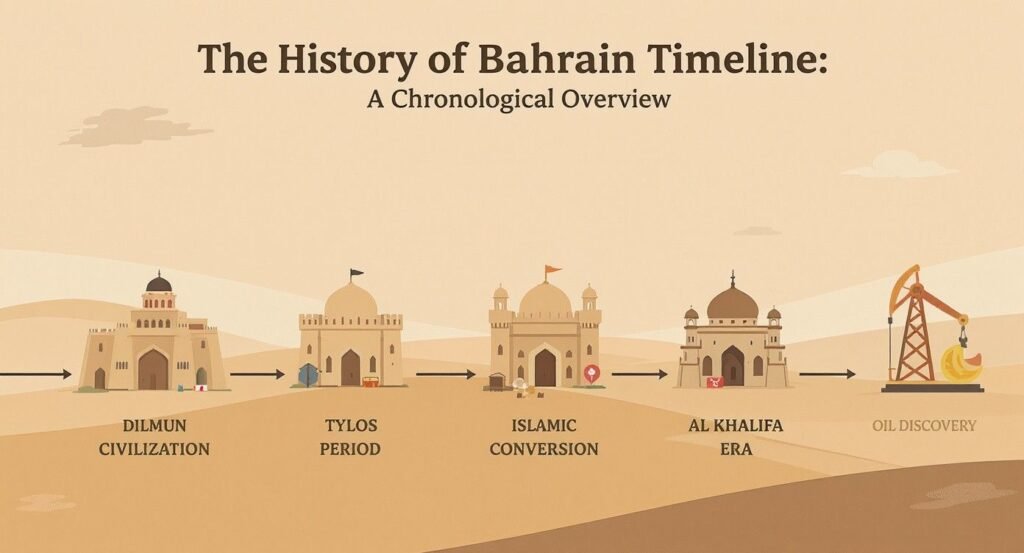
The History of Bahrain Timeline: A Chronological Overview
We have organised the island’s past into distinct eras to help you grasp its evolution. This timeline follows the progression from ancient trade routes to the modern constitutional monarchy.
- 3300 BC – 538 BC: The Dilmun Era. Bahrain was the capital of a powerful maritime empire. It controlled trade between Mesopotamia (modern Iraq) and the Indus Valley (modern Pakistan/India).
- 323 BC – 250 AD: The Tylos Period. Following the death of Alexander the Great, the Greeks influenced the island. They renamed it Tylos and established it as a centre for pearl trading and cotton plantations.
- 628 AD: The Islamic Conversion. Bahrain was one of the first regions outside central Arabia to accept Islam during the lifetime of the Prophet Muhammad.
- 1521 – 1602: Portuguese Occupation. European powers seized control of the island to dominate the lucrative Gulf trade routes. You can still see their influence in the architecture of the Bahrain Fort.
- 1783 – Present: The Al Khalifa Era. The Al Khalifa family established their rule, eventually leading the nation to full independence from British protection in 1971.
- 1932: Discovery of Oil. Bahrain became the first country on the Arabian side of the Gulf to discover oil, sparking a rapid shift in the economy.
Ancient Bahrain History: The Mystery of Dilmun
The Dilmun civilization Bahrain remains one of the most intriguing chapters in human history. Sumerian texts described it as a “pure” and “holy” land where death and disease did not exist. We now know that this was not just a myth. It was a highly organised commercial hub.
The people of Dilmun were the ultimate middlemen. They monopolised the copper trade from the mountains of Oman and shipped it to the great cities of Ur and Babylon. They used unique circular stamp seals to mark their goods, thousands of which have been found by archaeologists.
The Dilmun Burial Mounds
You cannot talk about ancient Bahrain’s history without mentioning the burial mounds. Over 170,000 mounds once dotted the landscape. In 2026, the UNESCO-listed sites in A’ali and Janabiyah offer a surreal view of the Bronze Age. These are not just piles of dirt. They are sophisticated stone chambers that prove the existence of a complex social hierarchy thousands of years ago.
Top Historical Places to Visit in Bahrain
We have curated a list of locations that provide the most value for cultural tourists. If you only have a few days, focus on these verified landmarks.
Qal’at al-Bahrain (Bahrain Fort)
This is the most important archaeological site on the island. It is a “tell,” meaning it is an artificial hill formed by layers of human occupation. We find the stratification fascinating. You are looking at the ruins of a Dilmun capital, a Kassite palace, and a Portuguese fortress all stacked on top of each other. Visit the on-site museum first to understand what you are seeing.
The Pearling Path (UNESCO World Heritage Site)
Located in Muharraq, this trail tells the story of Bahrain’s cultural heritage through its former economic engine: pearls. The path connects the homes of wealthy merchants with the humble shops of divers. We recommend walking the route in the late afternoon. You will see beautifully restored coral-stone architecture that captures the atmosphere of the pre-oil era.
Barbar Temple
This site consists of three successive temples built over a thousand years. It was dedicated to Enki, the god of wisdom and freshwater. The presence of a sacred natural spring at the centre of the temple explains why Bahrain was so vital. In an arid region, the island’s abundant freshwater made it look like a literal paradise to ancient travellers.
The Bahrain National Museum: Your Starting Point
We always advise our readers to start their journey at the Bahrain National Museum in Manama. It acts as a repository of 6,000 years of history. The museum is organised into halls that correspond with the timeline we discussed.
- Hall of Dilmun: This section houses the famous bronze bull’s head and thousands of stamp seals.
- Hall of Tylos and Islam: Here you can see the Greek influence on local pottery and the earliest Islamic inscriptions found on the island.
- Hall of Customs and Traditions: This is a fan favourite. It uses life-sized dioramas to recreate a traditional Bahraini souq and wedding ceremonies. It helps you connect the artefacts to the actual lives of the people who used them.
Bahrain History Facts for Tourists in 2026
To make your trip more engaging, we have gathered several essential facts that highlight the uniqueness of the Kingdom.
- The Name: “Bahrain” means “Two Seas” in Arabic. This refers to the unique phenomenon of freshwater springs bubbling up from the middle of the saltwater sea.
- The Tree of Life: An ancient acacia tree has stood in the middle of the desert for over 400 years with no apparent water source. Locals often link it to the mythical Garden of Eden associated with Dilmun.
- Oldest Mosque: The Al-Khamis Mosque is widely considered one of the oldest Islamic structures in the region, with foundations dating back to the late 7th century.
- The Pearl Monopoly: Until the 1930s, Bahraini pearls were considered the best in the world. Jacques Cartier, the famous jeweller, visited the island personally in 1912 to source the finest gems for his collections.
Why Understanding the Past Matters in 2026
We see a shift in how people travel. In 2026, travellers are moving away from “instagrammable” spots and toward places with real depth. Bahrain’s history provides that depth. When you walk through the Manama Souq today, you are following the same trade logic that the Dilmunites used 4,000 years ago.
The Kingdom is currently using its history to fuel its future. Programs like the “Pearling Path” are not just for tourists. They are urban renewal projects that keep the local community connected to their roots. We believe this makes Bahrain more authentic than many of its more famous neighbours.
Conclusion
The history of Bahrain is a lesson in resilience and trade. From the ancient Dilmun civilisation to the modern constitutional monarchy, the island has always relied on its ability to connect different worlds. We encourage you to look past the modern malls and spend time in the quiet ruins of the forts and temples.
By following our timeline and visiting the landmarks we suggested, you will gain a perspective on the Gulf that most travellers miss. Bahrain is not just a destination. It is a 6,000-year-old dialogue between East and West. We hope this guide serves as your companion as you explore the island’s incredible legacy.
FAQs
What is the best way to see the history of Bahrain in one day?
If you only have 24 hours, we recommend starting at the Bahrain National Museum at 9:00 AM. Spend the afternoon at Qal’at al-Bahrain (Bahrain Fort) and finish your day with a walk through the Pearling Path in Muharraq.
Is the Dilmun civilisation related to the Sumerians?
They were major trade partners. While Dilmun was an independent kingdom, its culture, writing, and religion were heavily influenced by the Sumerians of Mesopotamia. In fact, many Sumerian myths place their gods in the “paradise” of Dilmun.
Are the historical sites in Bahrain free to visit?
Some sites, like the burial mounds and certain parts of the Pearling Path, are free. Major attractions like the Bahrain National Museum and the Bahrain Fort have a small entry fee, usually around 1 to 2 BHD (£2 to £4).
Can I visit the burial mounds?
Yes. While many are protected, the royal mounds in A’ali are accessible and offer the best view of the sheer scale of the cemetery. There is no formal ticket office for many of these sites, so we suggest hiring a local guide to get the most out of the experience.
Is Bahrain’s history suitable for children?
Absolutely. The Bahrain National Museum is very kid-friendly, especially the dioramas in the Hall of Customs. The forts also provide plenty of space for children to explore while learning about ancient defence systems.
