


What is spread in forex? We break down the meaning, types, and hidden costs of spreads. Learn how to beat the bid-ask gap and save your trading capital.
We have seen countless beginners blow their trading accounts in the first month. They usually blame their strategy or the market direction. They rarely look at the silent cost that eats away their capital on every single trade. That cost is the spread.
If you want to survive in the currency markets, you must understand that trading is a business. Every business has operating costs. In Forex, the spread is your primary cost of doing business. It is not just a small number on your screen. It is the gap you must bridge before you make a single cent of profit.
We will explain exactly what spread is in forex, how brokers use it to make money, and why understanding this concept is the difference between a profitable trader and a gambler. We will cut through the noise and give you the practical facts you need for 2026.
What is spread in forex?
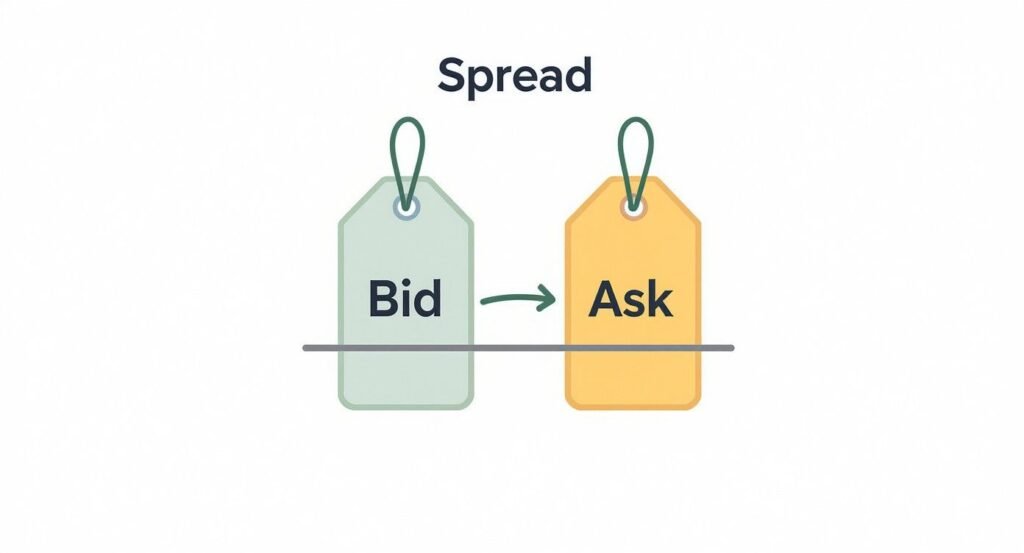
The spread is the difference between the buy (ask) price and the sell (bid) price of a currency pair. It is the fee you pay to your broker for executing your trade.
Think of it like a currency exchange booth at an airport. If you hand over dollars to buy euros, the booth gives you a specific rate. If you immediately hand those euros back to buy your dollars again, you get less money back. You did not lose money because the market moved. You lost money because of the spread.
In the Forex market, two prices always exist:
- Bid Price: The price at which the broker is willing to buy the base currency from you.
- Ask Price: The price at which the broker is willing to sell the base currency to you.
The ask price is always higher than the bid price. This gap ensures the broker makes money regardless of how the market moves. When you click “buy,” you enter the market at the higher price. When you click “sell,” you enter at the lower price. This means every trade you open starts in the negative. You must overcome this gap to break even.
The Role of the Liquidity Provider
Brokers are not the only ones involved here. Liquidity providers, such as major banks and financial institutions, create the initial market prices. Your broker takes these prices and adds a small markup. That markup is often the spread you see on your platform. We mention this because understanding the source of the price helps you understand why spreads change.
What is a spread in forex trading? The Calculation
You do not need a degree in mathematics to calculate the spread, but you do need to know how to read a quote. Forex quotes typically use four or five decimal places.
Let us look at a real-world example using the EUR/USD pair.
- Ask Price: 1.1052
- Bid Price: 1.1050
To find the spread, we subtract the bid price from the ask price.
1.1052 (Ask) – 1.1050 (Bid) = 0.0002
In Forex, we call the fourth decimal place a “pip.” So, a difference of 0.0002 equals 2 pips.
If you trade a standard lot (100,000 units), a 2-pip spread means you pay $20 simply to open the trade. If you trade a mini lot (10,000 units), that cost is $2. It sounds small, but we urge you to do the math over a year. If you place 500 trades a year with a standard lot, you pay $10,000 in spread fees alone. That is money gone from your account before you even predict a market move correctly.
Types of Spreads in the Forex Market
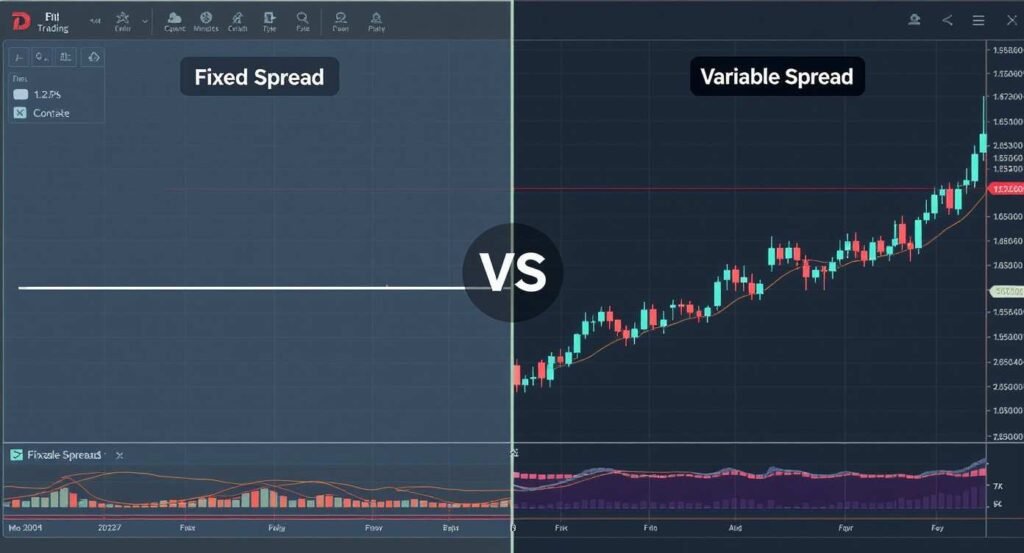
Not all spreads are created equal. Brokers offer different structures depending on their business model. Knowing what the spread in forex regarding structure is helps you choose the right broker for your style.
Fixed Spreads
A fixed spread stays the same regardless of market conditions. If the broker says the spread on EUR/USD is 2 pips, it remains 2 pips whether the market is quiet or chaotic.
Pros:
- Predictability: You know your cost upfront. This helps when calculating stop losses and take profit levels.
- Safety during volatility: During news events, fixed spreads protect you from sudden price gaps.
Cons:
- Higher average cost: Brokers usually charge a higher baseline spread to cover their risk.
- Requotes: If the market moves too fast, the broker may block your trade because they cannot honour the fixed price.
Variable (Floating) Spreads
A variable spread changes constantly. It tracks the real supply and demand in the market. When liquidity is high, the spread is tight (cheap). When liquidity is low, the spread widens (expensive).
Pros:
- Lower costs: During major trading sessions, variable spreads are often much cheaper than fixed spreads.
- Faster execution: These trades usually go directly to liquidity providers with no interference.
Cons:
- Unpredictability: What is spread in the forex market doing during a news release? It might jump from 1 pip to 20 pips in a second. This can trigger your stop loss unexpectedly.
What is the meaning of spread in forex regarding Volatility?
We see many beginners ignore volatility. This is a mistake. The spread is not static. It breathes. It expands and contracts based on fear and volume in the market.
Economic News Events
When high-impact news hits the wires, such as US Non-Farm Payrolls or interest rate decisions, liquidity disappears. Banks pull their orders to protect themselves. This causes the spread to widen massively. You might think you are entering a trade with a 2-pip cost, but if you click buy during a news spike, you might pay 10 or 15 pips.
Trading Sessions
The time of day matters. The spread is tightest when the major markets overlap. The London and New York sessions overlap (1:00 PM to 5:00 PM GMT), which usually offers the lowest spreads because millions of traders are active.
Conversely, if you trade during the “rollover” time (5:00 PM New York time), spreads can become enormous. This is when banking systems reset for the next day. We advise you strictly avoid scalping during these hours.
High Spread vs. Low Spread Pairs
You must select your battles carefully. Some currency pairs are cheap to trade, while others carry a heavy premium.
Major Pairs (Low Spread)
Pairs like EUR/USD, GBP/USD, and USD/JPY have high volume. Because so many people trade them, the spread is low. We recommend beginners stick to these pairs. The cost of entry is low, which gives you a better chance of survival.
Exotic Pairs (High Spread)
Pairs like USD/ZAR (South African Rand) or USD/MXN (Mexican Peso) are volatile and thin. The spreads here can be massive. You might see a 50 or 80-pip spread. What is spread in forex for an exotic pair? It is a barrier to entry. You need a massive market move just to cover the cost of opening the trade. Avoid these until you are experienced.
How Spread Relates to Trading Strategies?
Your trading style dictates how much the spread hurts you. We need to look at this relative to your profit targets.
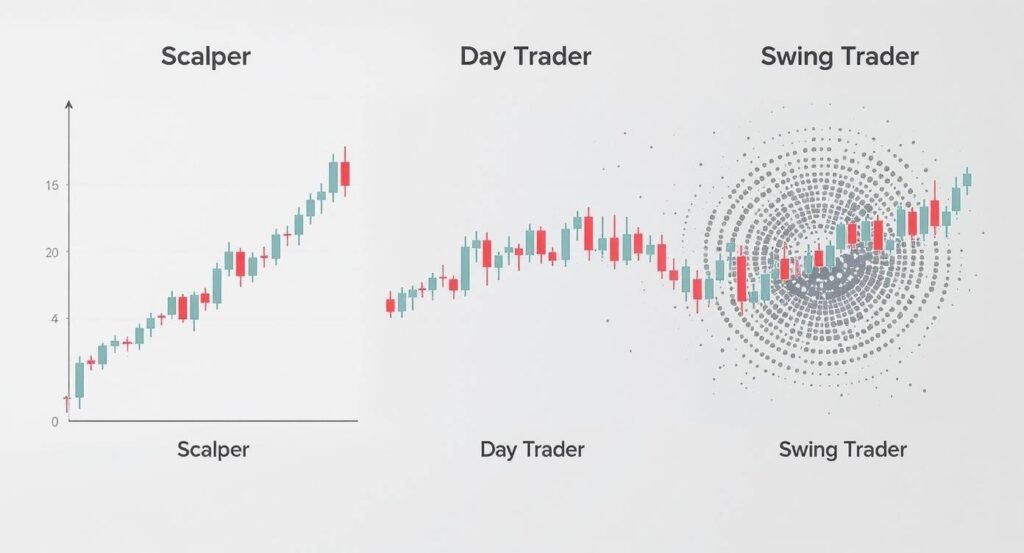
Scalpers
Scalpers are traders who try to grab small profits, perhaps 5 to 10 pips at a time. For a scalper, the spread is everything. If you target 5 pips of profit but pay 2 pips in spread, you give away 40% of your potential gain to the broker. That is a bad business model. Scalpers need raw, low-spread accounts (often called ECN accounts) to survive.
Day Traders
Day traders look for moves of 20 to 50 pips. The spread impacts them, but less severely. A 2-pip spread on a 50-pip target is a 4% cost. This is manageable, but you still need to be aware of widening spreads during news.
Swing Traders
Swing traders hold positions for days or weeks, looking for hundreds of pips. For them, what is a spread in forex trading? It is negligible. If you aim for 300 pips, a 3-pip spread is a 1% cost. Swing traders can afford to trade pairs with higher spreads because their profit targets are much larger.
The Hidden Cost: Spread vs. Commission
Brokers usually offer two pricing models. You need to pick the one that fits your math.
- Standard Account: Zero commission, but the spread is marked up. The broker builds their fee into the bid-ask price. This is simpler for beginners but often more expensive in the long run.
- Raw/ECN Account: The spread is effectively zero (or very low), but you pay a fixed commission per lot (e.g., $7 per round turn).
We often find that Raw accounts are cheaper for active traders. Do not be afraid of paying a commission if it means you get a tighter spread. A tight spread ensures your entry and exit prices are accurate.
How to Manage and Monitor Spreads?
You cannot control the spread, but you can manage how you react to it. We suggest incorporating these habits into your routine.
Enable the Spread Indicator
Most platforms, like MetaTrader 4 or 5, allow you to see the current spread on your chart. Turn this on. Never trade blind.
Check the Economic Calendar
Know when news is coming. If a big event is five minutes away, do not open a new trade. The spread will likely widen and put you at a loss immediately.
Use Limit Orders
Instead of buying at market price (where you pay the spread immediately), use limit orders. This allows you to set the price you want. While you still contend with the spread, it gives you more control over your entry point.
Comparing Brokers Based on Spreads
When you choose a broker from our lists, do not just look at the “minimum spread” they advertise. Brokers love to say “Spreads from 0.0 pips.” This is marketing. You need to look at the average spread.
The average spread tells you the truth about what is the spread in forex on their platform during normal hours. A broker might offer 0.0 pips for one second a day but average 1.5 pips the rest of the time. We analyse these averages to ensure you get a fair deal.
Conclusion
We want you to stop looking at the spread as a boring definition. It is the gatekeeper of your profits. What is spread in forex? It is the first hurdle you must jump. If the hurdle is too high, you will trip.
Trading is a game of probabilities and margins. By understanding the bid and ask price, choosing the right times to trade, and selecting liquid currency pairs, you lower your costs. When you lower your costs, you increase your profit margin.
Do not let the spread eat your account. Be aware of it. Account for it in your risk management. Treat your trading like the business it is. If you respect the cost of doing business, you stand a much better chance of surviving the volatility of 2026.
FAQs
What is a spread in forex trading regarding leverage?
Leverage allows you to trade larger positions, but it also magnifies the cost of the spread. If you use high leverage to open a large position, the cash value of the spread increases proportionally. A standard lot costs more in spread than a micro lot, even if the pip difference is the same.
What is the spread in forex for major pairs vs. minors?
Major pairs like EUR/USD usually have spreads between 0.6 and 1.5 pips on standard accounts. Minor pairs like EUR/GBP or AUD/NZD typically have spreads between 2.0 and 4.0 pips due to lower liquidity.
What is the meaning of spread in forex ECN accounts?
In an ECN (Electronic Communication Network) account, the spread is raw, meaning it comes directly from the banks. It can be as low as 0.0 pips. However, the broker charges a fixed commission per trade to make money, as they do not mark up the spread.
What is spread in the forex market at weekends?
The forex market closes on weekends. However, just before the close on Friday and at the open on Sunday (or Monday morning in Asia), spreads are usually at their widest. Liquidity is extremely thin during these times. We advise against holding short-term positions over the weekend to avoid paying these high costs.
Can the spread be negative?
Technically, no. The ask price is always higher than the bid price in a retail environment. In rare institutional instances, markets can become inverted, but retail traders will never see a negative spread. You always pay the gap.
